
Open enrollment asks you to make a large financial decision about your health from a stack of documents written in unfamiliar vocabulary. Deductible, coinsurance, formulary, network and out-of-pocket maximum all show up in the same comparison, and the deadline does not move. For Medicare, the annual enrollment period typically runs from October 15 to December 7. Marketplace and employer windows vary by state and by workplace, so confirm yours.

Much of the stress comes from three sources: too many options, terms you have not used before, and a deadline attached to a choice that affects your budget for a year. What helps most is reducing the decision to a few questions you can answer, working in short sessions, and getting a second set of eyes on the details. Small comfort habits, like a familiar scent on your desk, can make those sessions easier to sit through.
This article covers how to use essential oils for stress relief during that process, and where they stop being useful.
What essential oils can and can’t do for stress
Essential oils are concentrated plant extracts, and most people use them as aromatherapy: a scent in the room, a few drops in a diffuser, or a diluted blend on the skin. Many people find certain scents relaxing, and a scent you like can become a cue that tells you it is time to sit down and focus. The research on aromatherapy and stress is limited and mixed, and much of it comes from small studies. Treat the oils as a pleasant ritual, not a proven remedy.
Essential oils do not treat anxiety, depression or any medical condition, and they will not make a confusing plan document clearer. If stress or worry feels constant or is affecting your sleep, appetite or daily life, talk to your doctor or a mental health professional. The oils can sit alongside that care. They cannot replace it.
The most reliable benefit is behavioral. If you light the diffuser every time you do plan research, your brain starts to link that scent with a bounded, manageable block of work. That is a small effect, and it is a realistic one.
Three calming oils to start with, and how to use each safely
These three are widely available and commonly used for relaxation. If you are new to oils, our top 10 essential oils for beginners guide covers more of the basics.
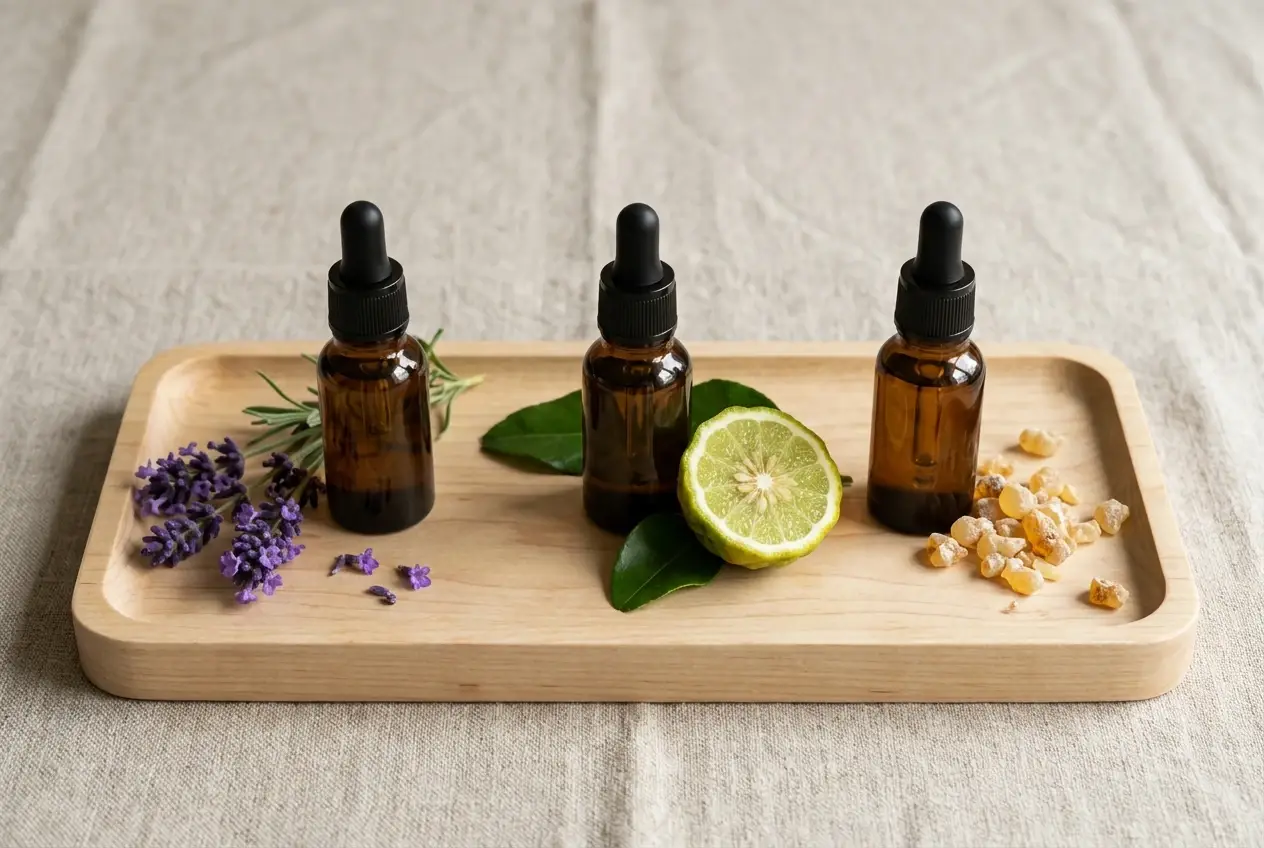
Lavender
Lavender is the most familiar calming scent: soft, floral and slightly herbal. It suits the longer, slower tasks, such as reading through a Summary of Benefits or comparing several plans side by side.
- In a diffuser: Add a few drops of water-based diffuser blend as directed by your diffuser’s instructions, and run it in intervals instead of all day.
- On skin: Dilute it in a carrier oil such as jojoba or fractionated coconut oil before it touches skin, and patch test a small area first.
Bergamot
Bergamot is a citrus oil with a bright, slightly floral smell. People often reach for it when they want to feel steady without feeling sleepy, which makes it a good choice for number-heavy work like comparing premiums and deductibles.
- In a diffuser: This is the simplest way to use it.
- On skin: Cold-pressed bergamot can make skin more sensitive to sun and cause a reaction. Unless the label states the oil is bergapten-free, keep it off your skin, especially before sun exposure.
Frankincense
Frankincense has a warm, woody, slightly resinous scent. It tends to suit quiet, reflective moments, like the point where you step back and decide which plan fits your life.
- In a diffuser: Use a drop or two, since it is a strong scent.
- On skin: Dilute it in a carrier oil and patch test first, as with any oil.
Buy oils from a seller that lists the plant’s Latin name and the country of origin, and store them tightly capped, away from heat and light.
A scent routine for your plan comparison sessions
Match the oil and the session length to the task. Short, focused sessions of 30 to 45 minutes work better than a single long evening, and you can make your scent routine part of the structure.

- Gather your documents (lavender). Before you open anything, collect your current plan information, a list of your doctors and the prescriptions you take. Start the diffuser, make a drink and set a timer. Nothing is being decided in this session, which keeps the pressure low.
- Open the plan documents (frankincense). Skim each plan’s summary and write down the monthly premium, the deductible, the out-of-pocket maximum and whether your doctors are in the network. Stop when the timer ends, even if you have not finished.
- Compare costs (bergamot). This is the numbers session. If the terms trip you up, keep our guide to comparing deductibles, copays and out-of-pocket maximums open next to you. Work out what each plan would cost you in a low-use year and in a high-use year.
- Medicare decisions (lavender or frankincense). If you are nearing 65 or reviewing Medicare coverage, schedule this on its own. Original Medicare, Medicare Advantage, drug coverage and supplement options each have their own rules, and mixing them into a general comparison session makes everything feel heavier.
- Make the call (your favorite of the three). Pick the plan that fits your budget and your doctors, confirm the enrollment steps and the deadline, and finish. Turn off the diffuser when you are done, so the scent marks the end of the work.
Safety notes: pets, kids, skin, pregnancy and your doctor
Essential oils are potent, and natural does not mean harmless. A few rules apply to everyone.
- Pets: Many essential oils can be harmful to cats and dogs, and cats are especially sensitive. Keep diffusers out of rooms your pets use, keep the room ventilated and make sure animals can leave the room. Ask your veterinarian before using any oil around them.
- Children: Young children are more sensitive to strong scents and oils. Ask your pediatrician before diffusing around a baby or small child, and keep all bottles out of reach. Swallowing essential oil can be dangerous.
- Skin: Never apply undiluted oil. Dilute in a carrier oil, patch test on a small area and stop if you see redness, itching or irritation. Keep oils away from eyes and mucous membranes.
- Pregnancy and nursing: Check with your doctor or midwife before using essential oils.
- Health conditions and medications: If you have asthma, allergies, a skin condition or any chronic illness, or you take medication, ask your doctor first. Strong scents can trigger breathing problems for some people.
- Ingestion: Do not swallow essential oils unless a qualified health professional has directed you to.
If a scent gives you a headache, nausea or trouble breathing, stop and air out the room.
The calmest fix is a clear plan: where to get help with your choices
A diffuser can make the room more pleasant, but the stress itself comes from uncertainty about the decision. These steps reduce it more than any scent will:

- Write down your own usage. List your doctors, your regular prescriptions and the care you expect to need in the coming year. Every plan comparison starts from this list.
- Narrow to two or three plans. Comparing twelve plans is exhausting. Drop any plan that excludes your doctors or your medications.
- Check the total, not only the premium. A low monthly premium with a high deductible can cost more in a year with heavy use. If the vocabulary slows you down, our beginner’s guide to health insurance terms explains each term in plain language.
- Know your deadline. Mark your window on the calendar and plan to finish a few days early.
- Ask for help. A licensed insurance professional can compare the options with you, check provider networks and drug coverage, and explain the enrollment steps. This is especially useful for Medicare, where the choices differ in ways that are hard to see from the outside.
Circle T Insurance helps individuals, families, the self-employed, and adults approaching 65 sort through health, Medicare, dental, vision and life insurance options. Whether you are changing jobs, running your own business or turning 65, a conversation can turn a pile of documents into a short list you understand.
Book a conversation with Circle T Insurance to go over your health, Medicare, dental or vision options before your enrollment window closes, and browse our essential oils for your own calm routine.